Only Vendor to Meet All Goals, Including Resistance to Look-Alike Fraud
San Francisco, CA — January 30 — Paravision, a leader in trusted Identity AI, today announced its results from the U.S. Department of Homeland Security (DHS) Science and Technology Directorate’s 2025 Remote Identity Validation Rally (RIVR), where Paravision was evaluated in the Selfie Match to Document (SMTD) track, a test that measures how accurately and securely a system can verify a person by matching a live selfie to a government-issued ID.
In this first of three DHS RIVR evaluation tracks, Paravision was among a small group of vendors that met DHS’s highest Goals across all core accuracy and reliability metrics — and the only vendor to also meet the rally’s most demanding Goal: maintaining < 0.01% false match rates when tested against demographically similar – look-alike – imposters.
Among the systems that met all standard RIVR Goals, Paravision demonstrated the lowest false match rate by a wide margin. Across nearly 8 million impostor comparisons, Paravision recorded 26 false matches, while other qualifying systems recorded between 60 and 146 false matches—representing approximately 2X to 5.6X higher error counts.
Independent DHS Evaluation of Real-World Remote Identity Verification
The Remote Identity Validation Rally is a DHS S&T–led evaluation designed to establish clear, operational benchmarks for remote identity verification technologies used in government services, financial onboarding, and secure digital access. The SMTD track assessed how accurately and securely commercial systems can verify that a live selfie belongs to the same person pictured on a genuine U.S. state-issued ID.
Sixteen systems were tested using 1,632 volunteers, multiple state ID formats, and three modern smartphones. Performance was measured using internationally recognized biometric metrics at a stringent false match rate of 1 in 10,000, consistent with federal digital identity guidance.
DHS RIVR distinguishes between minimum Thresholds (acceptable performance) and higher Goal levels intended to reflect mature, deployment-ready systems.
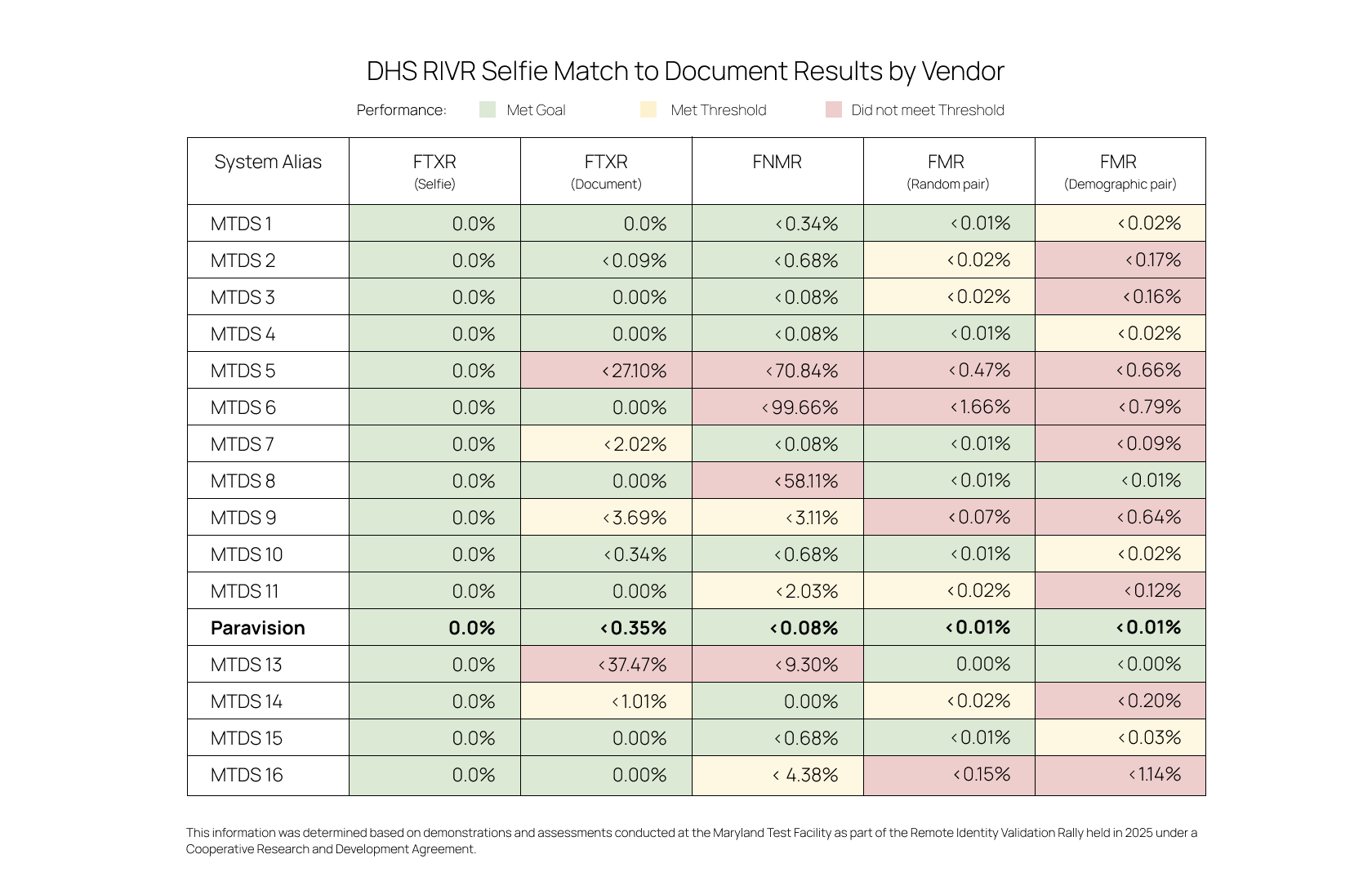
Paravision’s system (aliased as MTDS 12) met all Goals determined by DHS, which include:
| Metric | What it measures | Threshold | Goal |
|---|---|---|---|
| Selfie Failure-to-Extract Rate (FTXR) | How often the system fails to process a selfie | 5% | 1% |
| Document Failure-to-Extract Rate (FTXR) | How often the system fails to process an ID image | 5% | 1% |
| False Non-Match Rate (FNMR) | How often a legitimate user is incorrectly rejected | 5% | 1% |
| False Match Rate (FMR) | How often an impostor is incorrectly accepted | 0.05% | 0.01% |
According to DHS S&T’s published results:
- 31% of tested systems met RIVR Goals for all reported metrics
- 63% met RIVR minimal Thresholds across all metrics
- 37% failed to meet the Goal and Threshold for at least one metric
Setting the Bar for Real-World Fraud Resistance
Beyond standard accuracy metrics, DHS conducted an additional security-focused analysis designed to reflect realistic fraud behavior: measuring false match rates for demographically similar imposters — individuals of similar age, sex, and race.
This is a significantly more difficult test than random impersonation, addressing scenarios such as ID sharing or look-alike fraud, where attackers intentionally choose IDs that resemble their own appearance. DHS reported that, for the median system, false match rates were approximately 11X higher for demographically similar imposters than for randomly paired imposters — highlighting the importance of this analysis for operational security.
Of the 16 systems evaluated:
- Only three met the RIVR-determined false match rate Goal of < 0.01% for demographically similar imposters
- Paravision was the only system to meet the Goal while also meeting all other RIVR Goals
Overview of Results
Lower percentages indicate better performance across all metrics. Paravision (MTDS 12) was the only system to record near-zero false matches in both random and demographically similar impostor testing while maintaining low error rates across all other measures.
These results show that strong remote identity verification isn’t just about matching faces – it’s about resisting intentional, targeted fraud under real-world conditions. We’re proud to see Paravision recognized by DHS S&T for delivering both accuracy and security where it matters most.
Joey Pritikin, Paravision Chief Product Officer
About the DHS RIVR (Remote Identity Validation Rally)
The Remote Identity Validation Rally builds on DHS’s earlier Remote Identity Validation Technology Demonstration (RIVTD) and is designed to support government and industry stakeholders by defining achievable performance benchmarks and identifying areas for continued improvement. Additional RIVR tracks evaluating document authenticity and liveness detection are expected in subsequent phases.
The Remote Identity Validation Rally focuses on operational, deployment-ready testing, complementing NIST’s Face Recognition Technology Evaluations (FRTE), which measure algorithm performance under controlled laboratory conditions. Paravision’s strong results in DHS RIVR, alongside its leadership in NIST testing, demonstrate consistent performance across both rigorous lab evaluations and real-world operational deployments.
For more information on the DHS RIVR program and published results, visit mdtf.org.
Attribution & Disclaimer
This information was determined based on demonstrations and assessments conducted at the Maryland Test Facility as part of the Remote Identity Validation Rally held in 2025 under a Cooperative Research and Development Agreement. Use of these data in whole or in part does not constitute an endorsement by DHS S&T, the Maryland Test Facility (MdTF), or SAIC.
 More News