

White Paper: Contactless Corridor, V3 – A NEW ERA OF FRICTIONLESS IDENTITY

May 2025
A Vision Realized
In 2021, in recognition of a long-standing travel industry goal of providing truly frictionless and secure biometric identity for passengers on the move, Paravision introduced its first Contactless Corridor concept. While offering an innovative combination of AI-enabled face recognition and a modern design approach optimized for high-throughput environments, the initial design left open questions regarding the management of security and automation for large groups of travelers on the move.
In 2023, Paravision refined this vision with Contactless Corridor 2.0, scaling back aspects of unrestricted flow to create a more pragmatic and deployable solution. This iteration addressed critical security challenges by introducing managed flow constraints, improving feasibility within standard travel and border infrastructures.
Today, Paravision and AiFi are excited to present Contactless Corridor, V3 (“CC3”), a next-generation solution designed for real-world deployment. Designed in close collaboration, CC3 brings together Paravision’s Identity AI with AiFi’s Spatial Intelligence to deliver a truly frictionless, on-the-move biometric identity. The system is engineered to accommodate a range of security paradigms, operational footprints, and architectural requirements using conventional cameras and standard computing resources.
The Paravision + AiFi Breakthrough
Paravision Face Recognition has consistently demonstrated leading performance across diverse use cases, including digital identity verification, enterprise security, and travel and border applications. Likewise, Paravision’s SDKs, Docker Containers, and Search products allow for seamless integration with a wide range of endpoints and systems architectures.
The combination of technical capability and deployment flexibility enabled the Contactless Corridor from a purely biometric perspective, but it left operational challenges unresolved: specifically, how to manage biometric match results across multiple individuals in dynamic, chaotic spaces. Although Paravision Face Recognition could match faces effectively, it was unclear how to monitor individuals who failed matching, were not enrolled, or required special handling such as watchlist alerts.
AiFi’s Spatial Intelligence addresses this critical gap. Since 2017, AiFi has established leadership in Spatial Intelligence technology, initially developed for autonomous retail environments and now deployed globally across nearly 200 locations. Using standard IP cameras, AiFi’s technology enables three-dimensional tracking of people, actions, and objects in complex physical spaces, triangulating multiple angles through advanced computer vision techniques.
The integration of Paravision Identity AI and AiFi Spatial Intelligence enables CC3 to identify who is present, where they are, when they are there, and what they are doing – providing full situational awareness within crowded, high-flow environments. This layered approach to identity and spatial intelligence fundamentally redefines the operational possibilities for biometric corridors.
CC Main Components
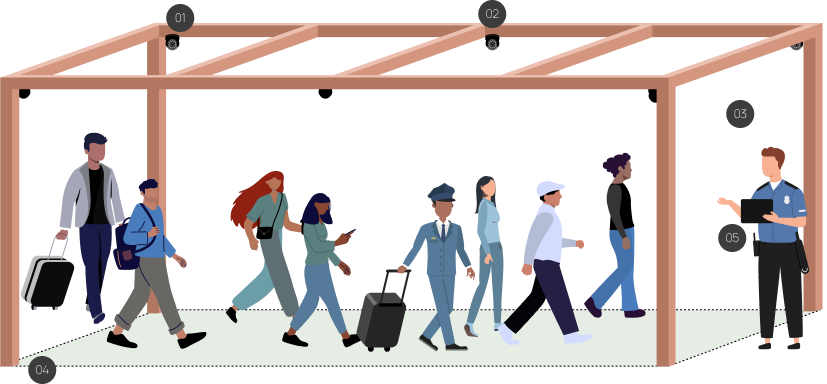
- Overhead IP Cameras: Strategically placed along the length of the corridor to provide complete 360-degree video coverage. The camera network ensures no blind spots and supports multi-angle face acquisition and motion tracking.
- Layered Vision AI: Combines face recognition and 3D motion tracking as a baseline, with the potential to integrate additional AI functions—such as detecting luggage, strollers, headwear, or eyewear—for enhanced situational context.
- Gate Access Controls: Where necessary, lightweight physical gates can be deployed at corridor exits. These may remain open and close selectively based on identity (e.g., unknown or watchlist), or stay closed and open for authorized individuals.
- Virtual Opt-In Zones: Invisible, precisely mapped digital zones that define where biometric identity is captured. These virtual “opt-in” areas are activated based on presence and movement—enabling privacy compliance without physical gates or barriers.
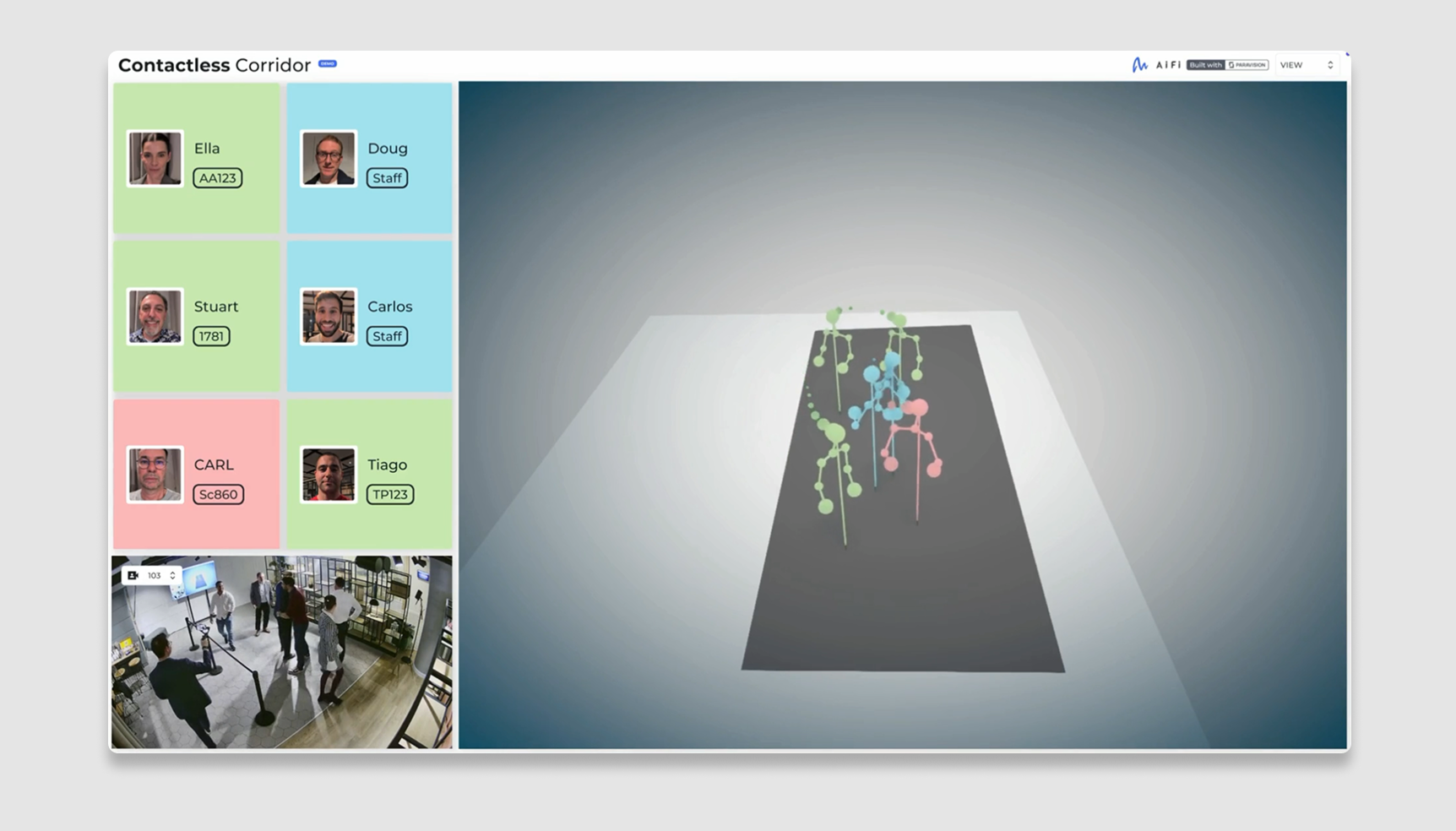
- Operator Interface: Security staff have access to a live dashboard showing corridor activity, identity status, and location of individuals. Role-based identities (e.g., staff, traveler, watchlist) are matched via Paravision Search, which may serve one or multiple corridors from a centralized system.
CC3 Core Capabilities
CC3’s advanced functionality is built upon several core capabilities :
- 360-Degree Visibility: CC3 simultaneously processes video inputs from multiple cameras to maintain continuous, 360-degree situational awareness throughout the entire corridor environment.
- Precision Location, Orientation, and Motion Tracking: The system determines individuals’ exact location, orientation, and movement status (including speed and direction).
- Layered Vision AI: CC3’s layers face recognition ision stack combines face recognition and 3D movement tracking. However, additional AI capabilities – such as luggage, stroller, headwear, or eyewear detection – could be easily integrated to extend functionality.
- Role-Based Biometric Identity: Utilizing Paravision Search, CC3 associates role-based metadata to identities, distinguishing between known travelers, employees, watchlisted people, and unknown individuals.
- Optimized Biometric Processing: CC3 applies only as much biometric processing as is necessary: Once a face is successfully matched, the system can discontinue redundant processing, optimizing computing resources.
- Physical and Computational Scalability: AiFi’s Spatial Intelligence enables CC3 to scale across environments from 10 square meters (100 sq ft) to thousands of square meters. Meanwhile, it is highly scalable from a backend computing perspective, enabling many corridors to integrate with a single Paravision Search implementation.
- Low-Cost, Commodity Hardware: CC3 operates with standard IP cameras and conventional server configurations (e.g., 24-core CPUs with mid-tier NVIDIA GPUs), significantly reducing hardware acquisition and maintenance costs. For a 10 square meter space, only 4 cameras are required. Such a setup would use a small fraction of a typical edge server (e.g. 24 core CPU + mid-tier NVIDIA GPU).
CC3 Benefits
Seamless, Frictionless Identity Experience
Travelers engaging with CC3 require no special actions for successful biometric identity capture. The system’s 360-degree camera coverage, combined with Paravision’s leading performance in handling off-angle, occluded, or poorly lit face images ensures reliable operation. This enables a seamless experience for travelers – who are often tired, stressed, unfamiliar with the technology, and navigating language barriers – without the need to follow specific instructions.
Flexible Journey Control
CC3’s precise tracking enables both fully automated and staff-guided traveler experiences. Simple gates at exit points can be configured as normally-closed (opening only for authorized individuals) or normally-open (closing selectively for unknowns or watchlist matches). Gate layouts may include secondary lanes or manual counters, supporting queue-free biometric travel at metro-level speed.
For staffed operations, agents within the corridor receive real-time, role-based insights showing only individuals who require attention—reducing cognitive load while enhancing both experience and security.
Advanced Anti-Tailgating and Occlusion Handling
The combination of a 360-degree view and precise individual tracking enables advanced tailgating prevention and effective exception handling even when people are in tightly spaced groups.
Similarly, CC3 handles occlusions—such as taller individuals blocking others—through its multi-angle view and Paravision’s ability to perform well on off-angle faces. If a face is too heavily occluded for recognition, the system can still detect the individual and classify them as “unknown,” enabling appropriate follow-up actions.
Deployment Flexibility
CC3 adapts to spaces of any size or layout—from compact 3×3 meter checkpoints to expansive, irregular corridors. It supports biometric and non biometric use cases, including person tracking, flow analytics, or hybrid setups with identity checks in designated zones.
Powered by AiFi Spatial Intelligence, CC3 creates virtual opt-in zones without physical barriers, enabling GDPR- and BIPA-compliant biometric capture. Whether travelers are moving continuously or waiting in line, CC3 delivers scalable, privacy-respecting identity assurance across the journey.
CC3 Use Cases
Air Travel and Border Control
In airports and border checkpoints, CC3 streamlines identity verification while maintaining strict security standards. Whether used at TSA-style pre-board screening, immigration control, or aircraft boarding zones, the system enables travelers to move continuously while being securely identified. Virtual opt-in zones allow CC3 to support biometric workflows that align with privacy and regulatory requirements, while its performance in challenging lighting and crowded environments ensures smooth processing for both frequent flyers and first-time travelers.
Events, Stadiums, and Large Venues
For sports arenas, concert halls, convention centers, and other venues, Contactless Corridor enables fast, secure, and seamless entry for thousands of guests. Attendees can be identified while in motion—without stopping or scanning a ticket—improving the guest experience and reducing bottlenecks. VIP guests and staff can be automatically recognized for access to restricted zones, and unknown individuals can be flagged in real time. CC3 also supports operational analytics such as flow tracking and dwell time insights for crowd management.
Enterprise Access and Workforce Management
In large-scale workplaces such as manufacturing plants, warehouses, or corporate campuses, the Contactless Corridor delivers secure and efficient identity verification for employees, contractors, and visitors. Integrated with enterprise access control or HRIS platforms, it ensures that only authorized personnel enter specific areas—without requiring badges or turnstiles. Role-based identity mapping supports complex staffing policies, shift changes, and audit trails, while CC3’s low-infrastructure footprint makes it cost-effective to deploy at multiple entry points across expansive sites.
Conclusion
Contactless Corridor V3 marks a significant advancement in biometric identity. By combining Paravision’s world-class face recognition with AiFi’s spatial tracking, CC3 delivers high-performance biometric verification, comprehensive situational awareness, and unparalleled operational flexibility. Through scalable architecture, commodity hardware, and adaptable workflows, the Contactless Corridor sets a new standard for traveler security, experience, and cost efficiency in the next generation of global transportation, access, and identity environments.