

White Paper: Australia Age Assurance Technology Trial Analysis

Executive Summary
The Australia Age Assurance Technology Trial (AATT) represents one of the world’s most comprehensive evaluations of age estimation technologies. This analysis focuses specifically on age estimation technology, highlighting the performance of Persona’s Age Assurance solution powered by Paravision Age Estimation.
Persona and Paravision work together as partners, with Persona utilizing Paravision’s age estimation model within its broader identity workflow. While this analysis evaluates performance based on AATT’s published results, the findings reflect the effectiveness of the combined solution as implemented and tested in the trial.
Our independent review of AATT data demonstrates that Persona’s age verification solution achieved the highest overall accuracy, outperforming competitors on key metrics and showing strong, real-world applicability.
Key Findings:
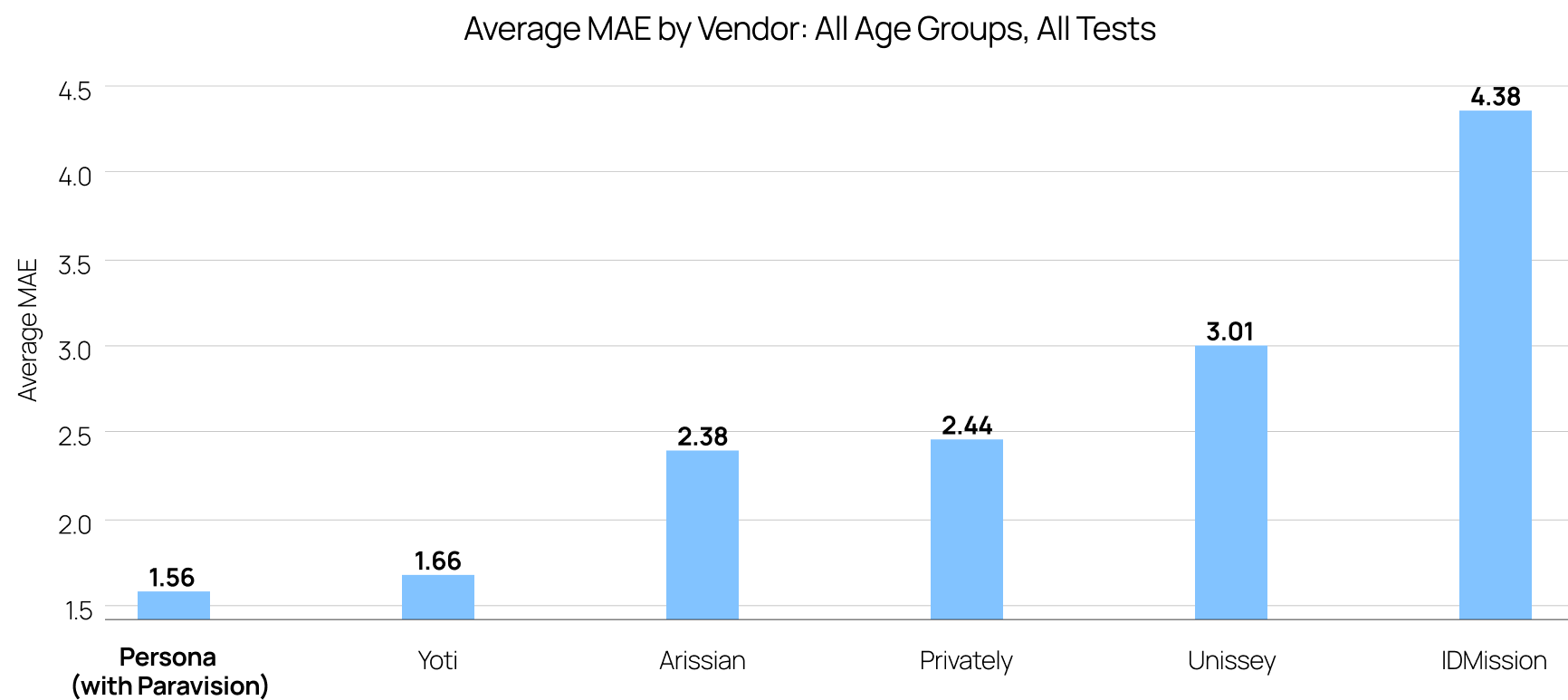
- Mean Absolute Error (MAE): Persona achieved an average MAE of 1.55 years, the best in the trial. The next closest competitor scored 1.66 years, with other participants trailing significantly.
- False Positive / False Negative Rates: Persona demonstrates low FPR and FNR across automated lab tests and school field trials, consistently performing well.
- Combined Consistency Metric: When combining FPR and FNR into a single performance metric, Persona emerges as the #1 overall performer on this metric.
- Buffer Safety Zone: All vendors’ results indicate that a buffer zone of approximately 2 years around age gates is effective for enabling secure and reliable age experiences.
1. Introduction to the Australia Age Assurance Technology Trial (AATT)
The AATT is an Australian government-supported initiative conducted in partnership with the Age Check Certification Scheme (ACCS), designed to evaluate age assurance solutions under both controlled and real-world conditions. The trial tested age gates at 13, 16, and 18 years – ages representing common regulatory thresholds.
Two main testing approaches were conducted. The first was an automated laboratory evaluation, designed to measure algorithmic accuracy under controlled conditions. The second was a school field trial, which introduced real-world complexities, such as diverse lighting conditions and user behavior. Metrics were reported for Mean Absolute Error (MAE), False Positive Rate (FPR), and False Negative Rate (FNR).
The AATT reports provided by each vendor are detailed, including charts, tables, and breakdowns across age groups and test types. This white paper distills the information, highlighting trends and delivering actionable insights for industry stakeholders.
1.1 The Importance of AATT
The AATT bridges the gap between controlled scientific testing and real-world deployment, assessing performance across multiple age gates, environments, and devices. Similarly to the DHS Remote Identity Verification Technology Demonstration (RIVTD), which focuses on liveness and identity verification in operational conditions, the AATT balances real-world testing with technical rigor.
The ACCS also provides certifications for Age Estimation, validating compliance and precision under defined conditions, but the AATT offers a broader comparative evaluation across multiple vendors, including both lab and field trials. Meanwhile, NIST FATE Age provides a rigorous, scientifically controlled laboratory benchmark, emphasizing algorithmic performance, reproducibility, and demographic considerations – important for research and development, but more limited in operational insights.
2. Persona & Paravision: The Partnership
Persona submitted its age estimation solution for the AATT, built with Paravision’s AI-based age estimation technology.
The partnership, established in 2023, combines Persona’s privacy-first approach with Paravision’s advanced AI models. Persona’s age verification platform powers solutions for high-profile customers across gaming, social media, and other digital platforms, such as Roblox and Reddit.
In addition to the AATT, Paravision has achieved Level 3 “Highly Effective Compliance” certification from the Age Check Certification Scheme (ACCS), including a 100% precision score in the optional ACCS Bias Evaluation.
For more information about Persona, visit withpersona.com and for more information about Paravision, visit paravision.ai. Read more about Persona and Paravision’s partnership here.
3. Key Age Estimation Accuracy Metrics and Terminology
Key metrics in the evaluation are:
- Mean Absolute Error (MAE): Measures the average deviation between predicted age and actual age. Lower values indicate more accurate age estimation.
- False Positive Rate (FPR): The rate at which underage users are incorrectly allowed access. Low FPR is essential for protecting minors.
- False Negative Rate (FNR): The rate at which users of valid age are incorrectly denied access. Low FNR means that legitimate users are not unnecessarily blocked.
These metrics together provide a holistic view of performance. While MAE reflects pure estimation accuracy, FPR and FNR indicate the balance of errors and usability in real-world systems.
4. Analysis
4.1 Methodology
The data from AATT includes a number of plots across vendors, age gates, and test types. While comprehensive, the granularity of the data makes it challenging to extract clear comparisons. To provide a digestible view of performance, we applied a structured methodology. A key step was averaging results across age gates and test types. This approach allowed us to create comparisons that are easier to interpret and provide a coherent picture of trends and performance. However, it is important to note that any averaging necessarily reduces specificity. Metrics derived in this way are unweighted and do not account for differences in sample sizes or testing conditions across groups, so while they are useful for overall insight, they should not be interpreted as perfectly precise reflections of the underlying raw data.
For some graphic analysis, we maintained separation between test environments, analyzing automated lab tests and school field trials independently to respect differences contexts. Finally, we developed a combined performance metric by integrating MAE, FPR, and FNR into a single visual representation. While this metric is not an official industry standard and does not directly represent real-world outcomes, it provides a useful way to illustrate overall consistency and balance across multiple dimensions of performance. This methodology allowed us to provide transparent, digestible insights while still reflecting the underlying detail of the AATT’s extensive data.
4.2 Age Estimation Accuracy – Mean Absolute Error
When averaging all tests and age groups, Persona achieved a Mean Absolute Error (MAE) of 1.56 years, the most accurate result in the trial. The second performer followed closely with 1.66 years, while all other vendors had significantly higher average error rates. This demonstrates that, on average, Persona + Paravision’s technology is the solution with the highest age estimation accuracy, as evaluated in the AATT. The MAE below was calculated by using the unweighted average across both field and automated tests
4.3 Age Estimation Accuracy – False Positive and False Negative Rates
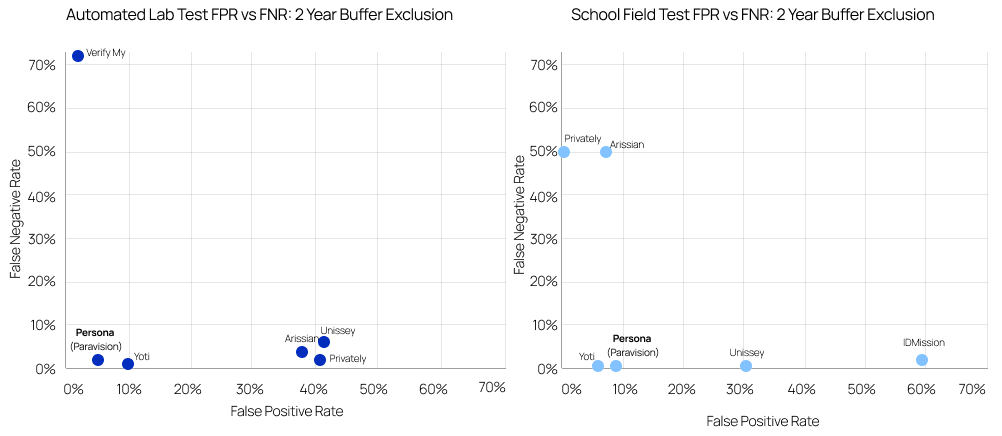
Examining the scatterplots of FNR versus FPR, Persona’s performance stands out. While other vendors may outperform Persona on specific metrics, the overall trend across environments favors Persona, highlighting both the robustness and real-world applicability of the technology. These comparisons use a two-year buffer zone exclusion, as recommended by AATT.

In the automated lab test – below left – Persona is closest to the lower-left ideal corner, indicating both minimal underage passes and minimal over-blocking of legitimate users. In the school field trial, Persona also demonstrates a leading FPR, while maintaining competitive FNR.
4.4 Age Estimation Accuracy – Combined Performance Metrics
To provide a holistic view, we developed a pillar chart combining FPR and FNR into a single visualization of overall consistency. Persona emerges as the leading performer, demonstrating a balance between high security, usability, and operational reliability.
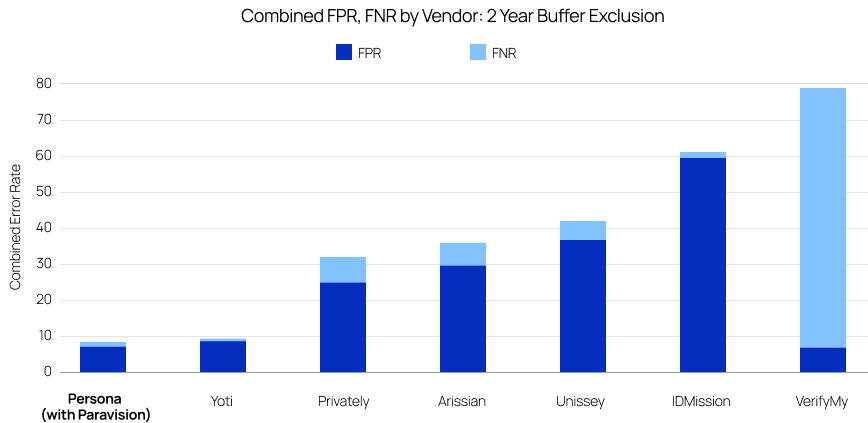
This approach emphasizes the importance of evaluating multiple metrics together. High performance in one area (such as MAE) is insufficient if FPR or FNR are elevated. Persona + Paravision delivers strong results across all critical dimensions simultaneously.
5. Conclusion
The results of the Australia Age Assurance Technology Trial, combined with Paravision’s independent ACCS certifications, demonstrate that the Persona + Paravision partnership delivers industry-leading accuracy, consistency, and fairness in age estimation. Across multiple metrics—including MAE, FPR, and FNR—our analysis shows that the solution performs reliably in both controlled laboratory settings and real-world field trials. This level of precision, operational robustness, and regulatory alignment underscores the readiness of Persona + Paravision’s age verification technology for deployment in high-stakes, age-restricted digital environments, providing confidence to businesses, regulators, and end-users alike.