Only Passive System to Meet All DHS RIVR PAD Thresholds, Demonstrating Superior Security, Speed, and Deployment Readiness
San Francisco, CA — March 12, 2026 — Paravision, a leader in trusted Identity AI, today announced its results from the U.S. Department of Homeland Security (DHS) Science and Technology Directorate’s 2025 Remote Identity Validation Rally (RIVR), Presentation Attack Detection (PAD) track.
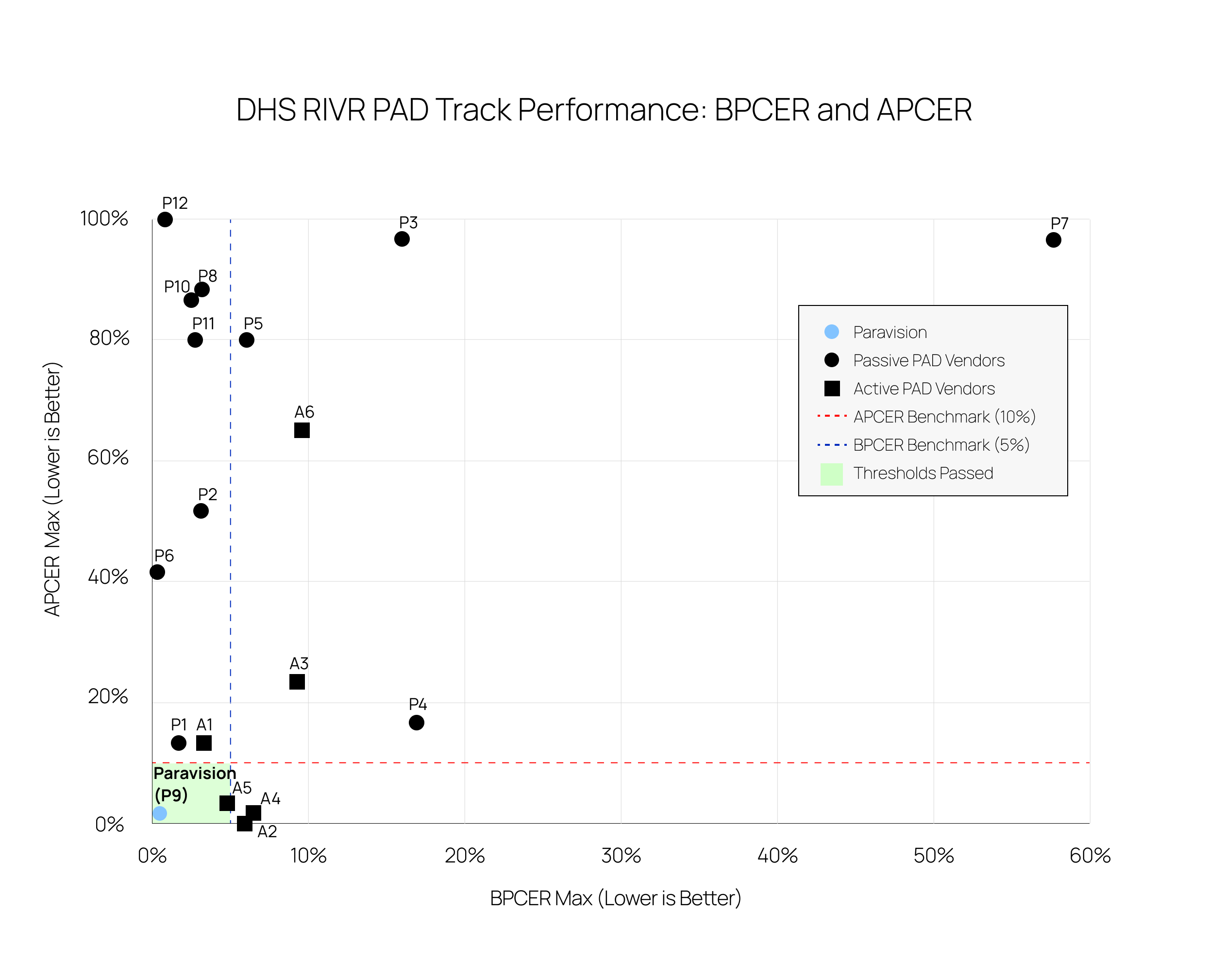
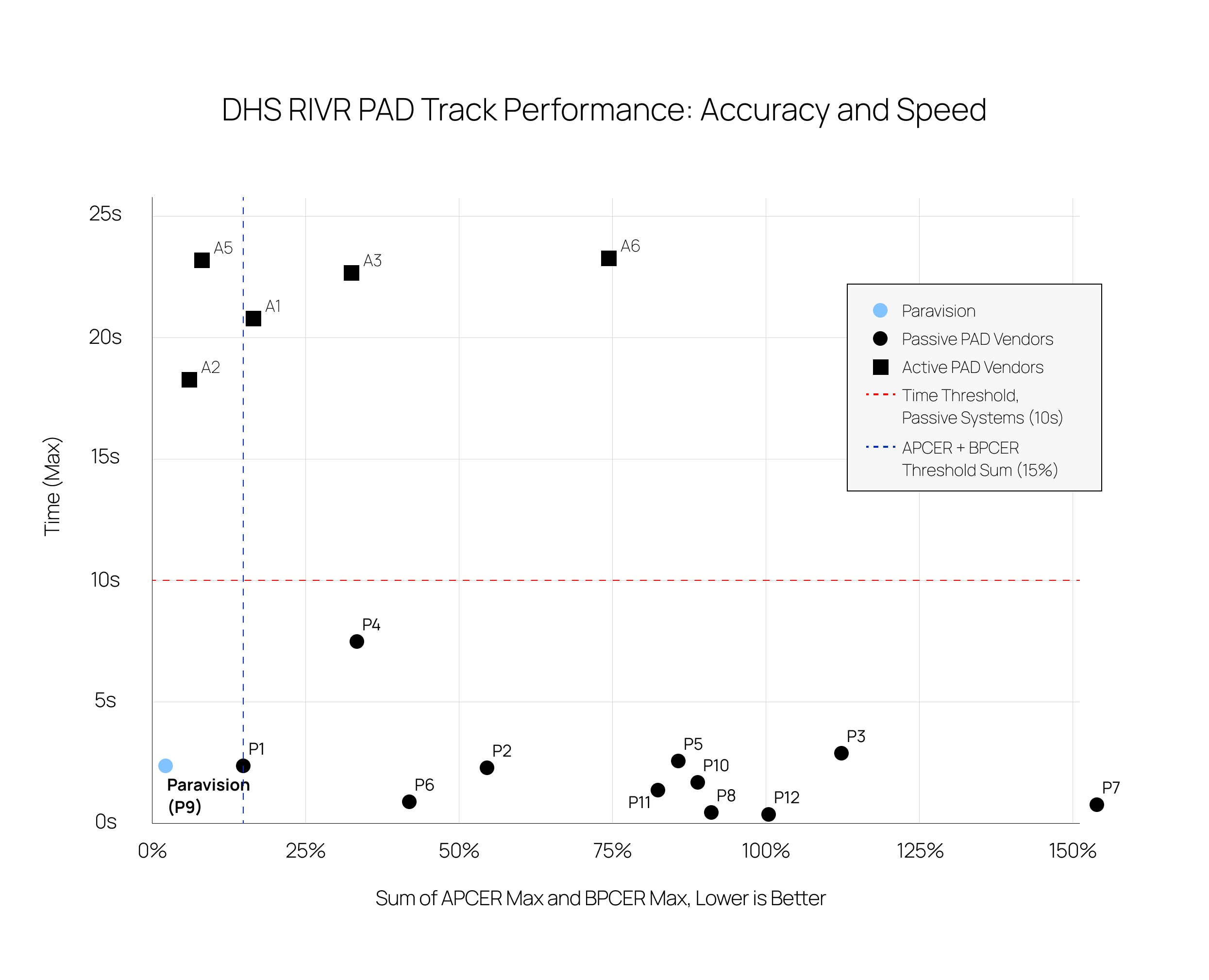
Following Paravision’s recent top-tier performance in the Selfie-to-ID track, the company’s PAD submission (alias P9) emerged as the only passive system to meet all DHS performance thresholds, while also outperforming the best-performing active system in both security and user experience.
These results highlight a meaningful shift in the market. Passive liveness has often been viewed as the weaker option compared to active approaches that require user interaction, but that is simply no longer the case. Our results demonstrate that with a sophisticated, AI-powered approach, passive PAD can deliver both robust fraud protection and a dramatically better user experience.
Joey Pritikin, Chief Product Officer at Paravision
Unmatched Security and Accuracy in DHS RIVR PAD Evaluation
The PAD track evaluated 18 systems (6 active and 12 passive) under real-world operational conditions using 645 demographically diverse volunteers and multiple smartphone devices, including iPhone 14, Samsung Galaxy S22, and Google Pixel 7.
Systems were tested against three classes of presentation attacks representing increasing levels of spoofing sophistication:
- Class A: low-effort attacks such as printouts and screen replays
- Class B: moderate-effort attacks such as masks or cutout photos
- Class C: high-effort attacks using specialized hardware or higher-cost spoofing methods
Performance was evaluated using two core biometric metrics:
- Bona Fide Presentation Classification Error Rate (BPCER) — how often legitimate users are incorrectly rejected
- Attack Presentation Classification Error Rate (APCER) — how often a system fails to detect a spoofing attempt
DHS defines minimum performance thresholds for these metrics to represent systems that are secure and reliable enough for real-world remote identity verification deployments. Paravision achieved industry-leading results:
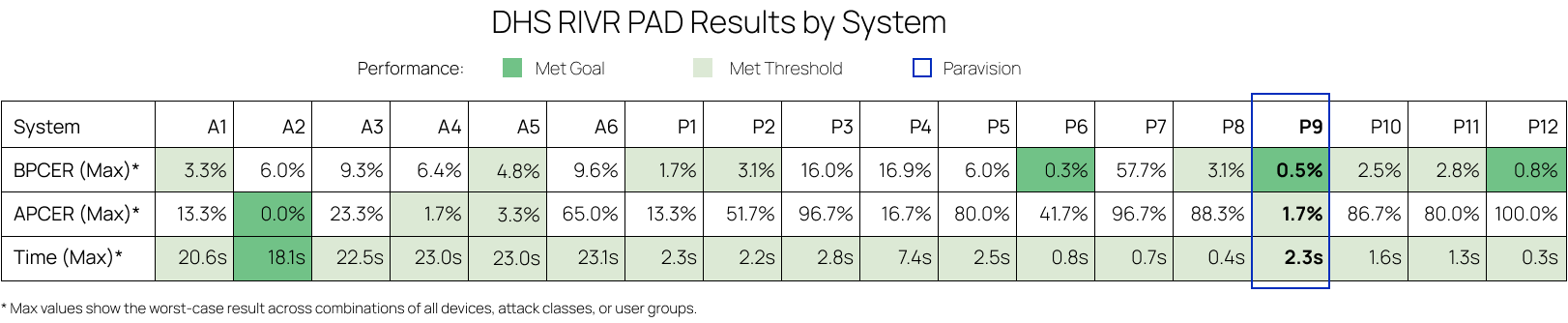
- APCER: 1.7% — the lowest across all passive systems, with the next-best passive system showing an error rate 8× higher
- BPCER: 0.5% — one of only three systems (active or passive) to meet the DHS goal
- Runtime: 2.3 seconds — approximately 10× faster than the best-performing active system (23 seconds)
Among the 12 passive systems tested, Paravision was the only one to meet all DHS RIVR PAD thresholds. Only one active system (A5) also met the thresholds. However, Paravision’s passive approach delivered stronger attack detection, lower user rejection rates, and dramatically faster transaction times.
Eliminating the Tradeoff Between Security and User Experience
Active PAD systems typically require users to perform actions such as head movements or engage with visual outputs during identity verification. While these steps help detect spoofing attempts, they also increase transaction time and introduce friction for legitimate users.
Passive systems analyze images automatically without requiring user interaction, enabling faster and more seamless verification. Paravision’s results demonstrate that a well-designed passive system can eliminate the traditional tradeoff between fraud prevention and user experience in remote identity verification.
In addition to strong security and speed, Paravision maintained stable performance across devices, age groups, and demographic segments. DHS reported that some active systems showed greater variability across populations, including higher error rates among older users.
Advancing Benchmarks for Remote Identity Verification and Liveness Detection
The RIVR PAD evaluation is part of DHS S&T’s ongoing effort to establish operational benchmarks for remote identity validation technologies and to help inform future NIST Digital Identity Guidelines.
Paravision’s results demonstrate that high-security passive liveness detection is achievable at scale, setting a new performance benchmark for the industry.
For more information on the DHS RIVR program and to view the full published results, visit mdtf.org.
NOTE: This information was determined based on demonstrations and assessments conducted at the Maryland Test Facility as part of the Remote Identity Validation Rally held in 2025 under a Cooperative Research and Development Agreement. Use of these data in whole or in part does not constitute an endorsement by DHS S&T, the Maryland Test Facility (MdTF), or SAIC.
 More News